






Elbow Pain and Common Elbow Conditions
The elbow is a combination of a hinge joint which allows the elbow to bend (flex) and strengthen (extend); and a pivot joint that allows it to rotate so you can bring your palm up and down.
Since the humerus fits perfectly into the forearm, the elbow functions as a very stable joint for most daily activities. However, aging-related wear-and tear, trauma, and repetitive motion can cause a range of issues, including inflammation, ligament and tendon tears, nerve damage, arthritis, dislocations, and fractures.
This page explains some of the common conditions that cause elbow pain, as well as some general treatment options. Your doctor can give you more detailed information about your elbow pain and come up with a plan to help relieve your symptoms.
Anatomy
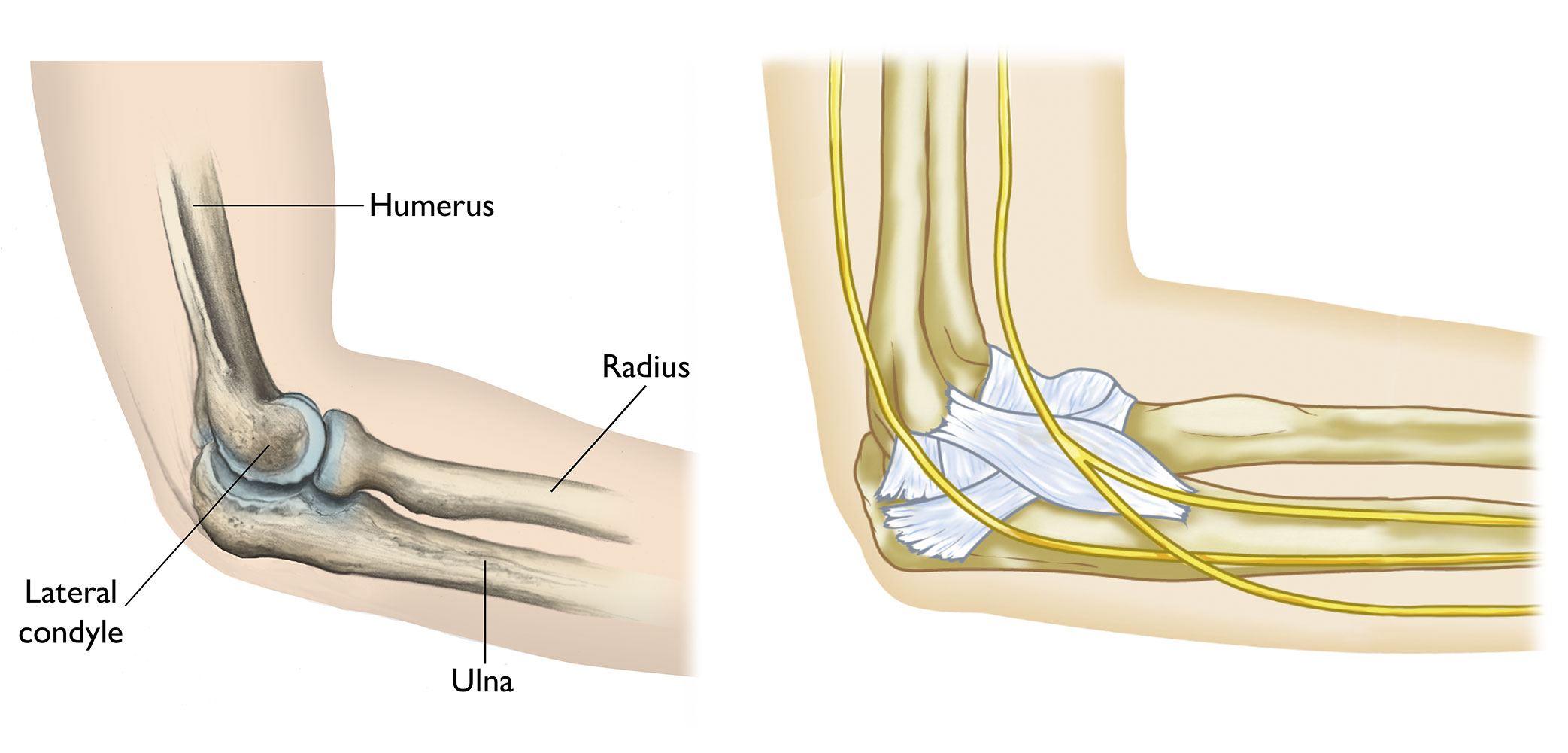
The elbow joint is made up of three bones:
- The humerus (upper arm bone)
- The ulna (forearm bone on the pinky finger side)
- The radius (forearm bone on the thumb side)
The surfaces of the bones where they meet to form the elbow joint are covered with articular cartilage, a smooth substance that protects the bones and enables them to move easily. A thin, smooth tissue called synovial membrane covers all remaining surfaces inside the elbow joint. In a healthy elbow, this membrane makes a small amount of fluid that lubricates the cartilage and eliminates almost any friction as you bend and rotate your arm.
Muscles, ligaments, and tendons — including the ulnar collateral ligament and biceps tendon — hold the elbow joint together and connect it to the upper and lower arm.
In addition, nerves — including the ulnar nerve — run through the elbow as they travel from the top of your arm to your hand.
Common Causes of Elbow Pain
Arthritis
Osteoarthritis of the elbow occurs when the cartilage surface of the elbow is worn out or damaged. This can happen because of a previous injury such as a dislocation or fracture. Most commonly, however, it is the result of a normal wearing away of the joint cartilage as we age and from years of activity. It usually occurs in people aged 50 and older but may occur in younger people, too. Symptoms include pain, loss of range of motion, and a grating or locking sensation in the elbow.
Learn more: Osteoarthritis of the Elbow
Though less common, other types of arthritis can affect the elbow, including rheumatoid arthritis and posttraumatic arthritis.
Soft Tissue Injuries (Acute and Overuse)
Elbow (Olecranon) bursitis occurs in the olecranon bursa, a thin, fluid-filled sac that is located at the boney tip of the elbow (the olecranon). Normally, the olecranon bursa is flat. If it becomes irritated or inflamed, more fluid will accumulate in the bursa and bursitis will develop. Symptoms include swelling, pain, redness and warmth to the touch.
Learn more: Elbow (Olecranon) Bursitis
Elbow Injuries in the Throwing Athlete. Overhand throwing places extremely high stresses on the elbow. Overhead throwing athletes (e.g., baseball pitchers and position players, softball position players, shot-putters, and javelin throwers) repeat these high stresses many times, which can lead to serious overuse injuries, including tendinitis, UCL injury, and ulnar neuritis.
Learn more: Elbow Injuries in the Throwing Athlete
An ulnar collateral ligament (UCL) injury most often occurs in overhead throwing athletes due to high repetitive stresses leading to an overuse injury. Surgical treatment for UCL tears includes reconstruction, better known as Tommy John Surgery. The goal of any treatment is to reduce pain and restore function.
Learn more: Ulnar Collateral Ligament (UCL) Injury
Ulnar Nerve Entrapment at the Elbow (Cubital Tunnel Syndrome) occurs when the ulnar nerve in the arm becomes compressed or irritated, causing symptoms like numbness and tingling in the pinky and ring fingers. In most cases, symptoms can be managed with nonsurgical treatments like changes in activities and bracing. If nonsurgical methods do not improve your symptoms, or if the nerve compression is causing muscle weakness or damage in your hand, your doctor may recommend surgery to take pressure off the nerve and allow it to move more freely.
Learn more: Cubital Tunnel Syndrome (Ulnar Nerve Entrapment at the Elbow)
Tennis elbow (lateral epicondylitis) is a painful condition of the elbow caused by overuse. Not surprisingly, playing tennis or other racquet sports can cause this condition. However, several other sports and activities can also put you at risk. Symptoms include pain and tenderness on the outside of the elbow.
Learn more: Tennis Elbow (Lateral Epicondylitis)
Fractures and Dislocations
A distal humerus fracture is a break in the lower end of the humerus (upper arm bone), one of the three bones that come together to form the elbow joint. A fracture in this area can be very painful and make elbow motion difficult or impossible. Treatment usually involves surgery to restore the correct bone position and hold the bone fragments together to allow for motion of the elbow.
Learn more: Distal Humerus Fractures of the Elbow
An olecranon (oh-LEK-rah-nun) fracture is a break in the bony tip of the elbow. It can break easily if you experience a direct blow to the elbow or fall onto the tip of the elbow. A fracture can be very painful and make elbow motion difficult or impossible. In most olecranon fractures, the pieces of bone move out of place when the injury occurs. For these fractures, surgery is required to restore both the normal anatomy of the elbow and motion in the joint.
Learn more: Elbow (Olecranon) Fractures
In an elbow dislocation, the joint surfaces of the elbow's three bones are separated. Elbow dislocations can be complete or partial and usually occur after a trauma, such as a fall, motor vehicle collision, or other accident. When the elbow dislocates, it is extremely painful; your arm will look deformed and may have an odd twist at the elbow.
Learn more: Elbow Dislocation
Radial head fractures are common elbow injuries. While trying to break a fall with your hands may seem instinctive, the force of the fall could travel up your forearm bones and break the smaller bone (radius) in your forearm. When this happens, it often involves the bulb-shaped head of the radius. Many elbow dislocations also involve fractures of the radial head.
Learn more: Radial Head Fractures of the Elbow
Recurrent and chronic elbow instability. Elbow instability is a sense of looseness in the elbow joint that may cause the joint to catch, pop, or slide out of place during certain arm movements. It most often occurs as the result of an injury — typically, an elbow dislocation. When the elbow is loose and repeatedly feels as if it might slip out of place, it is called recurrent or chronic elbow instability.
Learn more: Recurrent and Chronic Elbow Instability
Treatments for Elbow Pain
Many patients with elbow pain will respond to simple treatment methods such as altering activities, rest, physical therapy, and medication. However, surgery may be required to resolve some elbow problems.
These are some of the nonsurgical and surgical treatments commonly used to treat elbow pain. Some procedures can be done in the doctor's office or in the operating room on an outpatient basis, while others require a hospital stay.
- Casts and Splints
- Cortisone Shot (Steroid Injection)
- Cubital Tunnel Release
- Elbow Arthroscopy
- Platelet-Rich Plasma (PRP)
- Therapeutic Exercise Program for Epicondylitis (Tennis Elbow/Golfer's Elbow)
- Therapeutic Exercise Program for Radial Tunnel Syndrome
- Total Elbow Replacement
- What Are NSAIDs?
Because each patient is unique, your doctor will develop a treatment plan that is best for your condition and overall health, and that aligns with your goals.
AAOS does not endorse any treatments, procedures, products, or physicians referenced herein. This information is provided as an educational service and is not intended to serve as medical advice. Anyone seeking specific orthopaedic advice or assistance should consult his or her orthopaedic surgeon, or locate one in your area through the AAOS Find an Orthopaedist program on this website.
The content on this website may have been translated from English into other languages using artificial intelligence tools. The translations are provided for the convenience of readers and may not been reviewed or verified by medical professionals. AAOS makes no guarantees regarding the accuracy, reliability, or completeness of the translated information and disclaims all liability for any issues arising from its use. Users are strongly encouraged to refer to the original English content and consult qualified healthcare professionals before making any medical decisions. By using the translated content, you acknowledge and accept these limitations and assume full responsibility for any reliance on the information provided.