






Enfermedades y afecciones
Dolor de hombro y problemas habituales del hombro

Este artículo ha sido redactado y/o revisado por un miembro de la Asociación Americana de Cirujanos de Hombro y Codo (ASES).
Lo que la mayoría de la gente llama «hombro» es, en realidad, un conjunto de varias articulaciones que, junto con los tendones y los músculos, permiten una amplia amplitud de movimiento brazo, desde rascarse la espalda hasta lanzar una bola perfecta.
Sin embargo, la movilidad tiene su precio. Puede provocar problemas cada vez mayores de inestabilidad o pinzamiento de los tejidos blandos o las estructuras óseas del hombro, lo que da lugar a dolor. Es posible que sientas dolor solo al mover el hombro, o bien de forma constante. El dolor puede ser temporal o puede persistir y requerir un diagnóstico y un tratamiento médicos.
En este artículo se explican algunas de las causas más comunes del dolor de hombro, así como algunas opciones generales de tratamiento. Tu médico puede ofrecerte información más detallada sobre tu dolor de hombro.
Anatomía
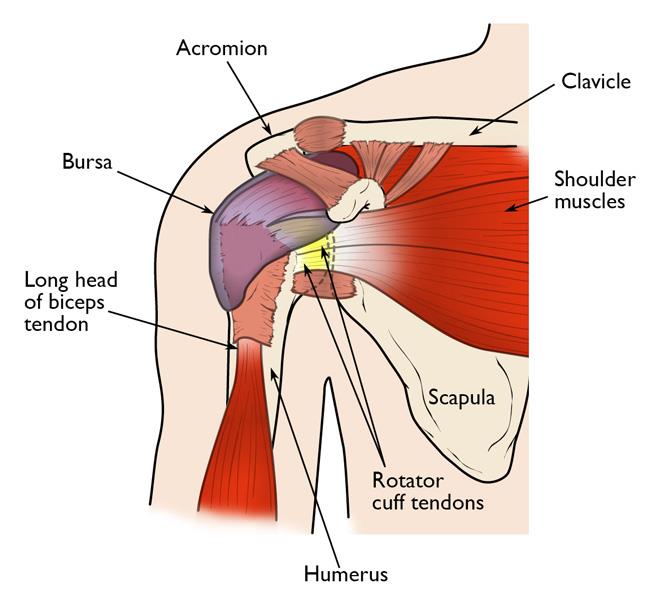
El hombro es una articulación esférica formada por tres huesos:
- El húmero (hueso del brazo)
- La escápula (omóplato)
- La clavícula
La cabeza del húmero encaja en una cavidad redondeada situada en el omóplato. Esta cavidad se denomina glenoides. Una combinación de músculos y tendones mantiene el húmero centrado en la cavidad del hombro. Estos tejidos se denominan manguito rotador. Recubren la cabeza del húmero y la unen al omóplato.
Causa
La mayoría de los problemas de hombro se clasifican en cuatro categorías principales:
- Inflamación de un tendón (bursitis o tendinitis) o rotura de un tendón
- Inestabilidad
- Artritis
- Fractura (hueso roto)
Otras causas mucho menos frecuentes del dolor de hombro son los tumores, las infecciones y los problemas relacionados con los nervios.
Bursitis
Las bursas son pequeñas bolsas llenas de líquido que se encuentran en las articulaciones de todo el cuerpo, incluido el hombro. Actúan como amortiguadores entre los huesos y los tejidos blandos que los recubren, lo que ayuda a reducir la fricción entre los músculos que se deslizan y el hueso.
En ocasiones, el uso excesivo del hombro provoca inflamación e hinchazón de la bursa el manguito rotador y una parte del omóplato conocida como acromion. El resultado es una afección denominada bursitis subacromial.
La bursitis suele aparecer junto con la tendinitis del manguito rotador. El dolor y la inflamación pueden dificultar muchas actividades cotidianas, como peinarse o vestirse.
Tendinitis
Un tendón es un cordón que une el músculo al hueso. La tendinitis se debe a una inflamación del tendón.
En general, la tendinitis puede ser de dos tipos:
- Aguda. Lanzar pelotas de forma excesiva o realizar otras actividades en las que se levanten los brazos por encima de la cabeza, ya sea en el trabajo o en la práctica deportiva, puede provocar una tendinitis aguda.
- Crónicas. Las enfermedades degenerativas, como la artritis, o el desgaste repetitivo debido a la edad, pueden provocar tendinitis crónicas.
Los tendones del hombro que se ven afectados con mayor frecuencia son los cuatro tendones del manguito rotador y uno de los dos tendones del bíceps. El manguito rotador está formado por cuatro músculos pequeños y sus tendones, que recubren la cabeza del húmero y la mantienen en la cavidad del hombro. El manguito rotador contribuye al movimiento y la estabilidad del hombro.
Más información: Tendinitis del bíceps, síndrome de pinzamiento del hombro/tendinitis del manguito rotador
Roturas de tendones
La rotura o desgarro de los tendones puede deberse a:
- Lesión aguda
- Cambios degenerativos en los tendones debidos al envejecimiento, al uso excesivo prolongado o al desgaste
Estas grietas pueden:
- Que sea parcial (que solo atraviese una parte del grosor del tendón)
- Separa completamente el tendón (despégalo) del punto en el que se inserta en el hueso.
Las lesiones del manguito rotador y del tendón del bíceps se encuentran entre las más frecuentes de este tipo.
Más información: Roturas del manguito rotador, rotura del tendón del bíceps en el hombro
Pinzamiento
El síndrome de pinzamiento del hombro se produce cuando la parte superior del omóplato (acromion) ejerce presión sobre los tejidos blandos subyacentes al levantar el brazo alejándolo del cuerpo. Al levantar el brazo, el acromion roza o «pinzona» los tendones del manguito rotador y bursa. Esto puede provocar bursitis y tendinitis, lo que causa dolor y limita el movimiento.
Más información: Síndrome de pinzamiento del hombro/tendinitis del manguito rotador
Inestabilidad
La inestabilidad del hombro se produce cuando la cabeza del húmero se sale de la cavidad articular del hombro. Esto suele ocurrir inicialmente como consecuencia de una lesión repentina, pero puede convertirse en crónica.
- Las luxaciones de hombro pueden ser parciales, es decir, que la cabeza del húmero solo se salga parcialmente de la cavidad articular. A esto se le denomina subluxación.
- Una luxación completa significa que la cabeza del fémur sale por completo de la cavidad articular.
Cuando los ligamentos, tendones y músculos que rodean el hombro se aflojan o se desgarran, pueden producirse luxaciones de forma repetida. Las luxaciones recurrentes (repetidas), que pueden ser parciales o completas:
- Provocan dolor e inestabilidad al levantar el brazo o al alejarlo del cuerpo
- Conllevan un mayor riesgo de desarrollar artritis en la articulación
Más información: Inestabilidad crónica del hombro, luxación del hombro
Artritis
El dolor de hombro también puede deberse a la artritis. Existen muchos tipos de artritis. El tipo más común de artritis en el hombro es la osteoartritis, también conocida como artritis por desgaste. Los síntomas, como el dolor y la rigidez, suelen aparecer a partir de la mediana edad. La osteoartritis se desarrolla lentamente y el dolor que provoca empeora con el tiempo.
La osteoartritis puede estar relacionada con lesiones deportivas o laborales, o con el desgaste crónico. Otros tipos de artritis pueden estar relacionados con desgarros del manguito rotador, infecciones o inflamación de la membrana sinovial.
A menudo, las personas evitan mover los hombros para intentar aliviar el dolor de la artritis. Esto a veces provoca una tensión o rigidez en los tejidos blandos de la articulación, lo que da lugar a una restricción dolorosa del movimiento.
Más información: Artritis del hombro
Fractura
Las fracturas son roturas de huesos. Las fracturas de hombro suelen afectar a la clavícula el húmero (hueso del brazo) y la escápula (omóplato).
Las fracturas de hombro en pacientes de edad avanzada suelen ser consecuencia de una caída desde la altura de pie. En pacientes más jóvenes, las fracturas de hombro suelen estar provocadas por un traumatismo de alta energía, como una colisión de vehículos a motor o un impacto en deportes de contacto (por ejemplo, una entrada en el fútbol o un choque contra las vallas en el hockey).
Las fracturas suelen provocar dolor intenso, hinchazón y hematomas en la zona del hombro.
Más información: Traumatismos en el hombro (fracturas y luxaciones)
Revisión médica
- En caso de una lesión aguda que provoque un dolor intenso, acude al médico lo antes posible.
- Si el dolor no es muy intenso, puede ser recomendable descansar unos días para ver si el problema se resuelve con el tiempo. Si los síntomas persisten, acude al médico.
Tu médico te realizará una evaluación exhaustiva para determinar la causa de tu dolor de hombro y te ofrecerá diferentes opciones de tratamiento.
Historial médico
El primer paso de la evaluación consiste en una historia clínica exhaustiva. Es posible que tu médico te pregunte:
- Cómo y cuándo empezó el dolor
- Si el dolor se ha presentado anteriormente y, en caso afirmativo, cómo se trató
- Otras preguntas que te ayudarán a determinar tanto tu estado de salud general como las posibles causas de tu problema en el hombro
Dado que la mayoría de las afecciones del hombro se agravan con determinadas actividades y se alivian con otras, la historia clínica puede ser una herramienta muy útil para determinar el origen de su dolor.
examen físico
Será necesario realizar un examen completo para determinar las causas de tu dolor de hombro. Tu médico:
- Busca anomalías físicas, hinchazón, deformidades y/o debilidad muscular.
- Comprueba si hay zonas sensibles
- Comprueba amplitud de movimiento la fuerza de tu hombro
Pruebas
Es posible que tu médico te pida unas pruebas concretas para ayudar a identificar la causa de tu dolor y cualquier otro problema.
- Radiografías. Las radiografías mostrarán cualquier lesión en los huesos que forman la articulación del hombro.
- Resonancia magnética (RM) y ecografía. Estas pruebas de imagen imágenes de mayor calidad que las radiografías de los tejidos blandos. La RM puede ayudar a tu médico a identificar lesiones en los ligamentos y tendones que rodean la articulación del hombro.
- Tomografía computarizada (TC). Una tomografía computarizada combina rayos X con tecnología informática para obtener una imagen muy detallada de los huesos de la zona del hombro.
- Pruebas electrodiagnósticas. Es posible que tu médico te pida una prueba, como una electromiografía (EMG), para evaluar la función nerviosa.
- Artrograma. Durante esta prueba radiológica, se inyecta un medio de contraste en el hombro para visualizar mejor la articulación y los músculos y tendones que la rodean. Puede combinarse con una resonancia magnética o una tomografía computarizada.
- Artroscopia. En esta intervención quirúrgica, el médico examina el interior de la articulación mediante una cámara de fibra óptica. La artroscopia puede revelar lesiones en los tejidos blandos que no se aprecian en la examen físico, las radiografías ni otras pruebas. Además de ayudar a determinar la causa del dolor, la artroscopia puede utilizarse para tratar el problema.
Tratamiento
Cambios en las actividades
El tratamiento suele consistir en:
- Descanso
- Modificar tus actividades
- Fisioterapia para ayudarte a mejorar la fuerza y la flexibilidad del hombro
Las soluciones basadas en el sentido común, como no excederse en actividades en las que normalmente no participas, pueden ayudar a prevenir el dolor de hombro.
Medicamentos
- Es posible que tu médico te recete medicamentos para reducir la inflamación y el dolor, como antiinflamatorios no esteroideos (AINE). Si se le recetan medicamentos para aliviar el dolor, debe tomarlos únicamente según las indicaciones.
- Es posible que tu médico también te recomiende inyecciones de anestésicos o esteroides para aliviar el dolor. Más información: Inyección de cortisona (inyección de esteroides)
Cirugía
En algunos casos, puede ser necesaria una intervención quirúrgica para resolver ciertos problemas del hombro. Sin embargo, la mayoría de los pacientes con dolor de hombro responderán a métodos de tratamiento sencillos, como modificar las actividades, el reposo, la fisioterapia y la medicación.
Es posible que ciertos tipos de problemas de hombro, como las luxaciones recurrentes y algunas roturas del manguito rotador, no respondan bien al ejercicio. En estos casos, puede recomendarse la cirugía en una fase bastante temprana.
La intervención quirúrgica puede consistir en una artroscopia para extirpar tejido cicatricial o reparar tejidos desgarrados, o bien en procedimientos abiertos tradicionales para reconstrucciones de mayor envergadura o la sustitución de la articulación del hombro.

Aportado y/o actualizado por
Revisado por pares por
La AAOS no respalda ningún tratamiento, procedimiento, producto ni médico mencionado en el presente documento. Esta información se facilita con fines educativos y no pretende constituir un consejo médico. Cualquier persona que necesite asesoramiento o asistencia ortopédica específica debe consultar a su cirujano ortopédico o buscar uno en su zona a través del programa «Buscar un ortopedista» de la AAOS, disponible en este sitio web.
El contenido de este sitio web puede haber sido traducido del inglés a otros idiomas mediante herramientas de inteligencia artificial. Las traducciones se facilitan para comodidad de los lectores y es posible que no hayan sido revisadas ni verificadas por profesionales sanitarios. La AAOS no ofrece ninguna garantía en cuanto a la exactitud, fiabilidad o exhaustividad de la información traducida y declina toda responsabilidad por cualquier problema que pueda derivarse de su uso. Se recomienda encarecidamente a los usuarios que consulten el contenido original en inglés y que acudan a profesionales sanitarios cualificados antes de tomar cualquier decisión médica. Al utilizar el contenido traducido, usted reconoce y acepta estas limitaciones y asume toda la responsabilidad por la confianza depositada en la información facilitada.