






Recuperación
Programa de acondicionamiento físico para el pie y el tobillo

Objetivo del programa
Tras una lesión o una intervención quirúrgica, un programa de acondicionamiento físico te ayudará a retomar tus actividades cotidianas y a disfrutar de un estilo de vida más activo y saludable. Seguir un programa de acondicionamiento bien estructurado también te ayudará a volver a practicar deporte y otras actividades recreativas.
Se trata de un programa de acondicionamiento físico general que ofrece una amplia variedad de ejercicios. Para garantizar que el programa sea seguro y eficaz para ti, debes realizarlo bajo la supervisión de tu médico. Consulta con tu médico o fisioterapeuta qué ejercicios te ayudarán mejor a alcanzar tus objetivos de rehabilitación.
Fuerza: Fortalecer los músculos que sostienen la parte inferior de la pierna, el pie y el tobillo te ayudará a mantener estable la articulación del tobillo. Mantener estos músculos fuertes puede aliviar el dolor en el pie y el tobillo, prevenir nuevas lesiones y favorecer la salud y la estabilidad de las extremidades inferiores.
Flexibilidad: Es importante estirar los músculos que se fortalecen para recuperar amplitud de movimiento prevenir lesiones. Realizar estiramientos suaves después de los ejercicios de fortalecimiento puede ayudar a reducir el dolor muscular y favorecer la movilidad articular y la salud muscular.
Músculos objetivo: Este programa de acondicionamiento se centra en los grupos musculares de la parte inferior de la pierna, así como en los tendones y ligamentos que controlan el movimiento de los pies. Entre ellos se incluyen:
- Complejo gastrocnemio-sóleo (pantorrilla)
- Músculo tibial anterior (espinilla)
- Músculo tibial posterior (centro de la pantorrilla)
- Peroneo largo (parte exterior de la pantorrilla)
- Peroneo corto (parte exterior de la pantorrilla)
- Fascia plantar (parte inferior del pie)
Duración del programa: Este programa de acondicionamiento para el pie y el tobillo debe seguirse durante un periodo de entre 4 y 6 semanas, salvo que tu médico o fisioterapeuta te indique lo contrario. Una vez recuperado, puedes seguir realizando estos ejercicios como programa de mantenimiento para proteger y cuidar la salud de tus pies y pantorrillas durante toda la vida. Realizar los ejercicios entre 3 y 5 días a la semana te ayudará a mantener la fuerza y amplitud de movimiento pie y el tobillo.
Primeros pasos
Calentamiento: Antes de realizar los siguientes ejercicios, calienta durante entre 5 y 10 minutos con una actividad de bajo impacto, como caminar o montar en bicicleta estática.
Estiramientos: Tras el calentamiento, realiza los ejercicios de estiramiento que se muestran en la página 1 antes de pasar a los ejercicios de fortalecimiento. Cuando hayas terminado los ejercicios de fortalecimiento, repite los ejercicios de estiramiento para finalizar el programa.
No ignores el dolor: no deberías sentir dolor mientras haces ejercicio. Consulta a tu médico o fisioterapeuta si sientes algún dolor al hacer ejercicio.
Haz preguntas: si no estás seguro de cómo realizar un ejercicio o con qué frecuencia debes hacerlo, o si notas que algo no va bien, ponte en contacto con tu médico o fisioterapeuta.
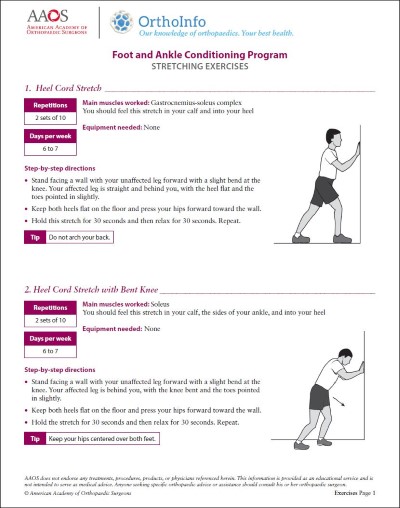
1. Estiramiento del tendón de Aquiles

Repeticiones: 2 series de 10
Días a la semana: de 6 a 7
Músculos principales que se trabajan: complejo gastrocnemio-sóleo
Deberías notar este estiramiento en la pantorrilla y hasta el talón
Material necesario: Ninguno
Instrucciones paso a paso
- Ponte de pie frente a una pared, con la pierna sana hacia delante y ligeramente flexionada por la rodilla. La pierna afectada debe estar estirada y detrás de ti, con el talón apoyado en el suelo y los dedos de los pies ligeramente hacia dentro.
- Mantén ambos talones apoyados en el suelo y empuja las caderas hacia delante, en dirección a la pared.
- Mantén este estiramiento durante 30 segundos y, a continuación, relájate durante 30 segundos. Repite el ejercicio.
Consejo: No arquees la espalda.
2. Estiramiento del tendón de Aquiles con la rodilla flexionada

Repeticiones: 2 series de 10
Días a la semana: de 6 a 7
Músculos principales que se trabajan: sóleo
. Deberías notar este estiramiento en la pantorrilla, a los lados del tobillo y hasta el talón.
Material necesario: Ninguno
Instrucciones paso a paso
- Ponte de pie frente a una pared, con la pierna sana hacia delante y ligeramente flexionada por la rodilla. La pierna afectada debe quedar detrás de ti, con la rodilla flexionada y los dedos de los pies ligeramente hacia dentro.
- Mantén ambos talones apoyados en el suelo y empuja las caderas hacia delante, en dirección a la pared.
- Mantén el estiramiento durante 30 segundos y, a continuación, relájate durante 30 segundos. Repite el ejercicio.
Consejo: Mantén las caderas centradas sobre ambos pies.
3. Rodar la pelota de golf

Repeticiones 1
Días a la semana Todos los días
Músculos principales que se trabajan: la fascia plantar
Deberías notar este ejercicio a lo largo de la planta del pie
Material necesario: una pelota de golf (otras opciones: una pelota de tenis o una botella de agua congelada)
Instrucciones paso a paso
- Siéntate en una silla estable con los dos pies bien apoyados en el suelo.
- Haz rodar una pelota de golf por el arco del pie afectado durante 2 minutos.
Consejo: Siéntate con la espalda recta y mantén el pie hacia la silla.
4. Estiramiento con toalla

Repeticiones: 2 series de 10
Días a la semana: de 6 a 7
Músculos principales que se trabajan: complejo gastrocnemio-sóleo
Deberías notar este estiramiento en la pantorrilla y hasta el talón
Material necesario: Toalla de mano
Instrucciones paso a paso
- Siéntate en el suelo con ambas piernas estiradas hacia delante. También puedes hacer este ejercicio sentado en una silla.
- Envuelve una toalla alrededor de la planta del pie afectado y sujeta los extremos de la toalla con las manos.
- Mantén la pierna afectada estirada y tira de la toalla hacia ti.
- Mantén la postura durante 30 segundos y, a continuación, relájate durante 30 segundos. Repite el ejercicio.
Consejo: Mantén la espalda recta y las piernas estiradas.
5. Elevaciones de pantorrillas (con las dos piernas o con una sola pierna)

Repeticiones: 2 series de 10
Días a la semana: de 6a 7
Músculos principales que se trabajan: complejo gastrocnemio-sóleo
Deberías notar este ejercicio en la pantorrilla
Material necesario: una silla para apoyarse
Instrucciones paso a paso
- Ponte de pie con el peso repartido uniformemente entre ambos pies. Agárrate al respaldo de una silla o a la pared para mantener el equilibrio.
- Si realizas elevaciones con las dos piernas, mantén ambos pies en el suelo. Si realizas elevaciones con una sola pierna, levanta del suelo el pie sano, de modo que todo tu peso recaiga sobre el pie afectado. Mantén recta la pierna o piernas sobre las que te apoyas.
- Levanta ambos talones (en el caso de las elevaciones a dos piernas) o solo el talón del pie afectado (en el caso de las elevaciones a una pierna) lo más alto que puedas y, a continuación, bájalo.
- Repite.
Consejo: Es posible que tu médico te indique que empieces haciendo elevaciones con ambas piernas. A medida que tu estado mejore, podrás ir apoyando más peso sobre el pie afectado, con el objetivo de llegar a levantar completamente del suelo el pie sano, de modo que todo tu peso recaiga sobre el pie afectado.
6. amplitud de movimiento del tobillo

Repeticiones: 2 series
. Días a la semana: Todos los días.
Músculos principales que se trabajan: Toda la musculatura del tobillo
Deberías notar este ejercicio en la parte superior del pie y en todo el tobillo
Material necesario: Ninguno
Instrucciones paso a paso
- Siéntate de manera que los pies no toquen el suelo.
- Escribe con el pie cada letra del alfabeto en el aire. Empieza con el dedo gordo del pie.
Consejo: Haz movimientos pequeños, utilizando solo el pie y el tobillo.
7. Recogida de canicas

Repeticiones: 20
Días a la semana: Todos los días
Músculos principales que se trabajan: flexores plantares
Deberías notar este ejercicio en la parte superior del pie y en los dedos de los pies
Material necesario: 20 canicas (también puedes usar bolas de algodón en lugar de canicas)
Instrucciones paso a paso
- Siéntate con los pies apoyados en el suelo y coloca 20 canicas en el suelo delante de ti.
- Utiliza los dedos de los pies para coger una canica cada vez y colócala en un cuenco.
- Repite el proceso hasta que hayas recogido todas las canicas.
Consejo: No coloques las canicas demasiado lejos hacia delante ni hacia los lados.
8. Rizos con toalla

Repeticiones: 20
Días a la semana: Todos los días
Músculos principales que se trabajan: la fascia plantar
. Deberías notar este ejercicio en la parte superior del pie y en los dedos de los pies.
Material necesario: Toalla de mano
Instrucciones paso a paso
- Siéntate con los dos pies apoyados en el suelo y coloca una toalla pequeña en el suelo delante de ti.
- Agarra el centro de la toalla con los dedos de los pies y enróllala hacia ti; después, relájate. Repite el movimiento.
Consejo: Puedes aumentar la dificultad de este ejercicio colocando un peso en el borde de la toalla.
9. Flexión dorsal y flexión plantar del tobillo

Repeticiones: 3 series de 10
Días a la semana: 3
Músculos principales que se trabajan: tibial anterior, complejo gastrocnemio-sóleo
Deberías notar este ejercicio en la pantorrilla, la espinilla, la parte posterior del talón y la parte superior del pie
Material necesario: utiliza una banda elástica con una resistencia que te resulte cómoda
Instrucciones paso a paso
- Siéntate en el suelo con las piernas estiradas hacia delante. También puedes realizar este ejercicio sentado en una silla.
- Para realizar la dorsiflexión, fija la banda elástica a la pata de una silla o una mesa y, a continuación, envuélvela alrededor del pie. Tira de los dedos del pie hacia ti y vuelve lentamente a la posición inicial. Repite el ejercicio.
- Para realizar la flexión plantar, envuelve la banda elástica alrededor del pie y sujeta los extremos con la mano. Estira suavemente los dedos de los pies y vuelve poco a poco a la posición inicial. Repite el ejercicio.
Consejo: Mantén la pierna estirada y el talón apoyado en el suelo para mantener el equilibrio.
10. Equilibrio sobre una sola pierna

Repeticiones: de 3 a 5
Días a la semana: de 6 a 7
Músculos principales que se trabajan: tibial anterior, complejo gastrocnemio-sóleo
Este ejercicio debe realizarse con calzado cómodo, preferiblemente zapatillas para caminar
Material necesario: Una superficie de apoyo estable, como una silla o una encimera
Instrucciones paso a paso
- Colócate junto a una superficie de apoyo y apoya ambas manos sobre ella, con los dos pies en el suelo.
- Mantén ambas rodillas rectas y levanta un pie en el aire, manteniendo el equilibrio sobre la pierna afectada.
- Retira las manos de la superficie de apoyo, volviéndolas a colocar cuando sea necesario para evitar perder el equilibrio.
- Mantén el equilibrio sobre una sola pierna durante un máximo de 30 segundos, apoyándote de vez en cuando si lo necesitas. Repite el ejercicio.
Consejo: Hazlo sin zapatos para que sea más difícil.
Aportado y/o actualizado por
Revisado por pares por
La AAOS no respalda ningún tratamiento, procedimiento, producto ni médico mencionado en el presente documento. Esta información se facilita con fines educativos y no pretende constituir un consejo médico. Cualquier persona que necesite asesoramiento o asistencia ortopédica específica debe consultar a su cirujano ortopédico o buscar uno en su zona a través del programa «Buscar un ortopedista» de la AAOS, disponible en este sitio web.
El contenido de este sitio web puede haber sido traducido del inglés a otros idiomas mediante herramientas de inteligencia artificial. Las traducciones se facilitan para comodidad de los lectores y es posible que no hayan sido revisadas ni verificadas por profesionales sanitarios. La AAOS no ofrece ninguna garantía en cuanto a la exactitud, fiabilidad o exhaustividad de la información traducida y declina toda responsabilidad por cualquier problema que pueda derivarse de su uso. Se recomienda encarecidamente a los usuarios que consulten el contenido original en inglés y que acudan a profesionales sanitarios cualificados antes de tomar cualquier decisión médica. Al utilizar el contenido traducido, usted reconoce y acepta estas limitaciones y asume toda la responsabilidad por la confianza depositada en la información facilitada.