






Diseases & Conditions
Distal Radius Fractures (Broken Wrist)
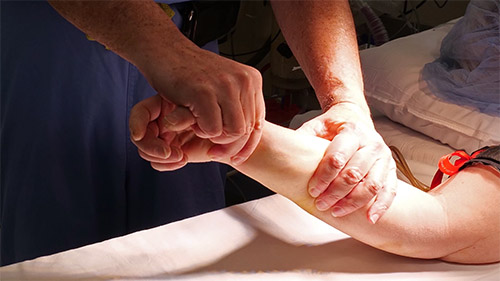

A distal radius fracture is a break of the radius bone close to the wrist. The radius is one of the two long bones in the forearm.
Distal radius fractures are very common. In the U.S., about 1 out of every 6 broken bones treated in the emergency room is a distal radius fracture.
In young people, these fractures typically occur in high-energy accidents, such as a fall from a ladder or a motor vehicle collision. In older people, especially those with osteoporosis, distal radius fractures can occur from a simple fall onto the wrist.
Anatomy of the Forearm
There are two long bones that make up the forearm:
- The radius is on the thumb side of the forearm.
- The ulna is on the small finger (pinky) side.
Near the elbow, the ulna is the larger of the two bones. Near the wrist, the radius is the larger bone.

Types of Distal Radius Fractures
There are many different ways the radius bone can break. Some of the specific patterns of breaks in the distal radius are known by the people who first described them. This very common fracture can occur in many different ways to people of all ages.
One of the most common distal radius fractures is called a Colles fracture. In this type of fracture, the broken piece of the radius tilts backwards toward the back of the wrist. It is named after Dr. Abraham Colles, who first described it more than 200 years ago.

Distal radius fractures can also be described by where they break or other factors associated with the break. Some of these include:
- Intra-articular fracture. In this fracture, the break extends into the wrist joint ("articular" means "joint").
- Extra-articular fracture. In this fracture, the break does not extend into the wrist joint.
- Open fracture. When a broken bone breaks through the skin, it is called an open fracture. This type of fracture needs prompt medical attention because it can lead to an infection.
- Comminuted fracture. When a bone is broken into many pieces, it is called a comminuted fracture.
It helps doctors to describe fractures by the way the bone breaks so they know how to treat them and communicate with other people about the break. Some types of fractures are harder to treat than others. Fractures that extend into the joint, break through the skin, or break into several pieces are often more difficult to treat. A fracture is also harder to treat if the broken bone pieces have moved out of place. This is called a displaced fracture.
Sometimes, the other bone of the forearm (the ulna) breaks, too. This is called a distal ulna fracture. Depending on the type of fracture, you may not need more treatment.

Causes of Distal Radius Fractures
The most common cause of a distal radius fracture is a fall onto an outstretched arm.
Osteoporosis is a condition that makes bones weak and more likely to break. It is common in older adults. With osteoporosis, even a minor fall can cause a broken wrist. Many distal radius fractures in people over the age of 60 are caused by a fall from a standing height. Learn more: Fragility Fractures FAQ
A broken wrist can also happen in healthy bones if the force of the injury is severe enough. For example, a car crash or a fall off a bike or scooter can break the wrist of a young and healthy person.
Symptoms of a Distal Radius Fracture
A distal radius fracture usually causes immediate pain, swelling, bruising, and pain when you touch the wrist. The wrist may also look bent or out of place.
In very severe fractures, the nerves in the hand can be injured or compressed. This causes numbness in the fingers. If your fingers feel numb after a wrist injury, go to an emergency room right away. Getting treatment quickly can help stop permanent nerve injury.
Rarely, a broken forearm bone can cause two serious problems. One is called compartment syndrome, which happens when pressure builds up in the forearm. The other is called acute carpal tunnel syndrome, which happens when pressure builds up on a nerve in the wrist.
Go to an emergency room right away if you have:
- Severe pain that does not get better or gets worse
- Severe pain when someone gently straightens your fingers
- New weakness or trouble bending your thumb or index finger
These conditions are medical emergencies and need treatment right away.
Diagnosing a Distal Radius Fracture
If the injury is not very painful and your wrist does not look bent or out of place, you may be able to wait until the next day to see a doctor. Until a doctor is able to examine your wrist:
- Wear a splint to protect your wrist.
- Apply ice (20 minutes on, 20 minutes off). Do not apply ice directly to the skin. Wrap the ice in a towel or use an ice pack.
- Keep your wrist raised above the level of your heart.
These signs mean you should go straight to an urgent care center or the emergency room:
- The injury is very painful
- The wrist looks badly bent or out of place
- Your fingers are numb or pale
Your doctor will likely order X-rays of the wrist. X-rays can show if the bone is broken and if the broken pieces have moved out of place. They can also show how many pieces the bone has broken into.
Sometimes, your doctor may order a computed tomography (CT) scan. A CT scan creates detailed pictures of the bone that can help your doctor plan surgery if it is needed.

Treatment of Distal Radius Fractures
There are many treatment options for a distal radius fracture. The choice depends on different things, such as the type of fracture, your age and activity level, and your surgeon's judgment.
Nonsurgical Treatment
If the broken bone is in a good position, your doctor may put you in a cast until the bone heals.
If your broken bone has moved out of place and could affect how well your wrist works, your doctor may need to put the bone back into the correct position. This is called a reduction. In some cases, such as in children who are able to realign the break with growth, or in older adults who have low demands on their wrist, a reduction may not be needed.
Before the procedure, you may be given medicine to help control pain. Then, your doctor gently pulls and moves your wrist to guide the broken bone back into the correct position without making a cut in the skin. Afterward, X-rays are taken to measure to make sure the bone is lined up correctly. Your wrist is then placed in a splint to hold the bone in place while it heals.
A splint is usually used for the first few weeks after the injury. This allows room for normal swelling. A cast is sometimes put on after the swelling goes down. The cast is often changed later because it can become loose as more swelling goes away.
Depending on the type of fracture, your doctor may closely watch your bone healing by taking regular X-rays. If you do not have surgery, you might need X-rays every week for the first 3 weeks and another X-ray at 6 weeks. If the fracture is stable, you may need fewer X-rays. If the bone moves out of place while it is healing, your doctor may say you need surgery.
If you do not need surgery, your doctor will usually remove the cast about 4 to 6 weeks after the fracture happened. At that point, you will likely start physical therapy to help improvement and strength in your wrist. Between therapy sessions, you can wear a removeable splint to protect your wrist while it continues to heal.
Surgical Treatment
Sometimes, a doctor cannot put the bone back into the corect position without surgery. In other cases, the bone cannot stay in place with just a cast. If the bone heals out of position, it can change how well your wrist and arm work. In these cases, you may need surgery to put the bone back into position and hold it there while it heals.
Procedure. During surgery, your doctor may make a cut over the broken bone to reach the fracture. Then, they carefully protect important tissues like blood vessels, nerves, and tendons. The broken bone is then moved back into the correct position. After the bone is put back in place, your doctor uses metal supports to hold the bone steady while it heals. Depending on the type of fracture, these may include metal plates, screws, pins, or a metal support structure outside your body (external fixation). Your doctor will explain the best option for you.
If you have an open fracture where the bone breaks through the skin, the timing of your intervention may be quicker to avoid an infection. In the emergency room, your doctor will clean the injured area and give you antibiotics to help prevent infection. Depending on the type of fracture, sometimes a surgery with fixation will be planned and sometimes the bone will be held in place with a splint.


Recovery After a Distal Radius Fracture
Recovery is different for everyone. This is because the kinds of distal radius fractures and their treatment options are so different and because your body's response to the injury and your medical health are unique. Talk to your doctor about your recovery plan. Ask when you can return to normal activities.
Most distal radius fractures take about 3 months to heal enough for you to use your wrist for all activities. Full recovery from these injuries can take up to 1 year.
Pain Management
Most fractures hurt for a few weeks. The goal of pain management is not to take away all the pain, but to make the pain more manageable. It is unrealistic to expect that your recovery will be pain-free. Many patients find that using ice, elevation (holding their arm above their heart), and over-the-counter pain medications will help their pain.
Your doctor may recommend taking ibuprofen and acetaminophen together to help control pain and swelling, if your medical conditions allow. Taking both medications together works better than taking either one alone. If pain is severe, your doctor may prescribe a stronger medication, such as an opioid, for a short time. Sometimes, if you have surgery, part of the anesthesia will involve a nerve block, which can help with pain relief after surgery.
Opioids can help with severe pain, but their use has risks and complications. These medications can be addictive and potentially dangerous. It is therefore important to use opioids only as your doctor tells you to, to use as little as possible for as short a time as possible, and to stop taking them as soon as your pain gets better. Talk to your doctor if your pain is not getting better within a few days of your surgery.
Cast and Wound Care
During healing, keep your casts or splint dry because water can weaken it and make it less effective at protecting your wrist. Moisture trapped inside the case can also cause skin problems.
When you shower, cover your arm with a plastic bag to help keep it from getting wet. If the cast does become wet, it will not dry very easily. A hair dryer on the cool setting may help. In many cases, wet casts need to be replaced.
Keep your surgical incision (the cut made during surgery) clean and dry to help it heal and keep you from getting an infection until your doctor tells you otherwise. Your doctor will tell you when it is safe to remove the bandages after surgery and when it is OK to get the incision wet.
Potential Complications
After surgery or casting, work on moving your fingers as soon as possible.
Tell your doctor if you cannot fully move your fingers within 24 hours because of pain and/or swelling. Your doctor may need to loosen your cast or surgical dressing. If needed, you may work with a physical or occupational therapist to help your fingers and wrist move and work normally again.
Severe, ongoing pain that does not get better may be a sign of complex regional pain syndrome (reflex sympathetic dystrophy). This condition causes pain and changes how the nerves work. It needs to be treated. Tell your doctor if you have severe pain that does not get better with medication.
Rehabilitation and Return to Activity After a Distal Radius Fracture
Most people will go back to all their normal activities after a distal radius fracture. How well you recover depends on the type of injury, the treatment you got, and how your body responds. In some cases, you may have permanent limitations in how your wrist works.
Almost all patients will have some stiffness in their wrist. This will usually get better in the month or two after the cast is taken off or after surgery. It keeps getting better for at least 2 years. If your doctor thinks you need it, you will start physical therapy within a few days to weeks after surgery, or right after your last cast is taken off.
Most patients can return to light activities, such as swimming or exercising the lower body in the gym, within 1 to 2 months after the cast comes off or within 1 to 2 months after surgery. More demanding activities, such as skiing or football, may be resumed between 3 and 6 months after the injury.
Long-Term Outcomes After a Distal Radius Fracture
Full recovery will take at least 1 year.
- Some pain with harder activities is normal for up to 1 year after the fracture.
- Some people can also have mild stiffness or aching for 2 years or longer
- In some cases, the stiffness and aching can last forever. This is more common after severe injuries like motorcycle crashes), in people over age 50, or in people with osteoarthritis. However, the stiffness is usually mild and typically does not change how well the arm works.
Finally, osteoporosis (weak bones) is a common cause of wrist fractures, especially in older adults. Any type osteoporosis-related fracture is called a "fragility fracture." Other common places for fragility fractures to occur are the hip, spine, and shoulder.
A fragility fracture is often the first sign that a person has weak bones. After a distal radius fracture, your doctor may recommend testing your bones for weakness, especially if you have other risk factors for osteoporosis.
It is very important to diagnose and treat osteoporosis as early as possible to avoid future fractures that could affect your independence. Having one fragility fracture almost doubles your risk of having another fracture, and the risk is highest within the first year or two after the first fracture. Ask your doctor about osteoporosis testing.
For more information, watch: Distal Radius Fractures (Broken Wrist) Overview
To assist doctors in the management of distal radius fractures, the American Academy of Orthopaedic Surgeons has conducted research to provide some useful guidelines. These are recommendations only and may not apply to every case. For more information: Plain Language Summary- Clinical Practice Guideline - Distal Radius Fractures - AAOS
Contributed and/or Updated by
Peer-Reviewed by
AAOS does not endorse any treatments, procedures, products, or physicians referenced herein. This information is provided as an educational service and is not intended to serve as medical advice. Anyone seeking specific orthopaedic advice or assistance should consult his or her orthopaedic surgeon, or locate one in your area through the AAOS Find an Orthopaedist program on this website.
The content on this website may have been translated from English into other languages using artificial intelligence tools. The translations are provided for the convenience of readers and may not been reviewed or verified by medical professionals. AAOS makes no guarantees regarding the accuracy, reliability, or completeness of the translated information and disclaims all liability for any issues arising from its use. Users are strongly encouraged to refer to the original English content and consult qualified healthcare professionals before making any medical decisions. By using the translated content, you acknowledge and accept these limitations and assume full responsibility for any reliance on the information provided.